

Picture this: it's 11pm, you're sitting at the kitchen table with your laptop open, and you've just plugged your address into three different online valuation tools while wondering whether a free property appraisal in Auckland would give you a clearer answer. The first tool says $1.1 million. The second says $1.35 million. The third offers something helpfully in the middle. You close the laptop feeling no more certain than when you started, except now you're also slightly anxious.
Many Auckland homeowners begin their selling journey exactly this way, and it's also where the biggest misconceptions take root. A free, no-obligation property appraisal in Auckland from a qualified local agent is a fundamentally different exercise from an automated online estimate, and many homeowners may not realise how much more it covers. This article walks you through exactly what a well-done appraisal includes, what to bring to your appointment, and how the whole process helps you arrive at a confident selling decision rather than another round of late-night guesswork.
At Team Thompson, our appraisals for Epsom, Mt Eden, and Central Auckland properties go well beyond a rough price range, factoring in zoning classifications, flood plain status, and the kind of street-level detail that only comes from working these neighbourhoods week in, week out.
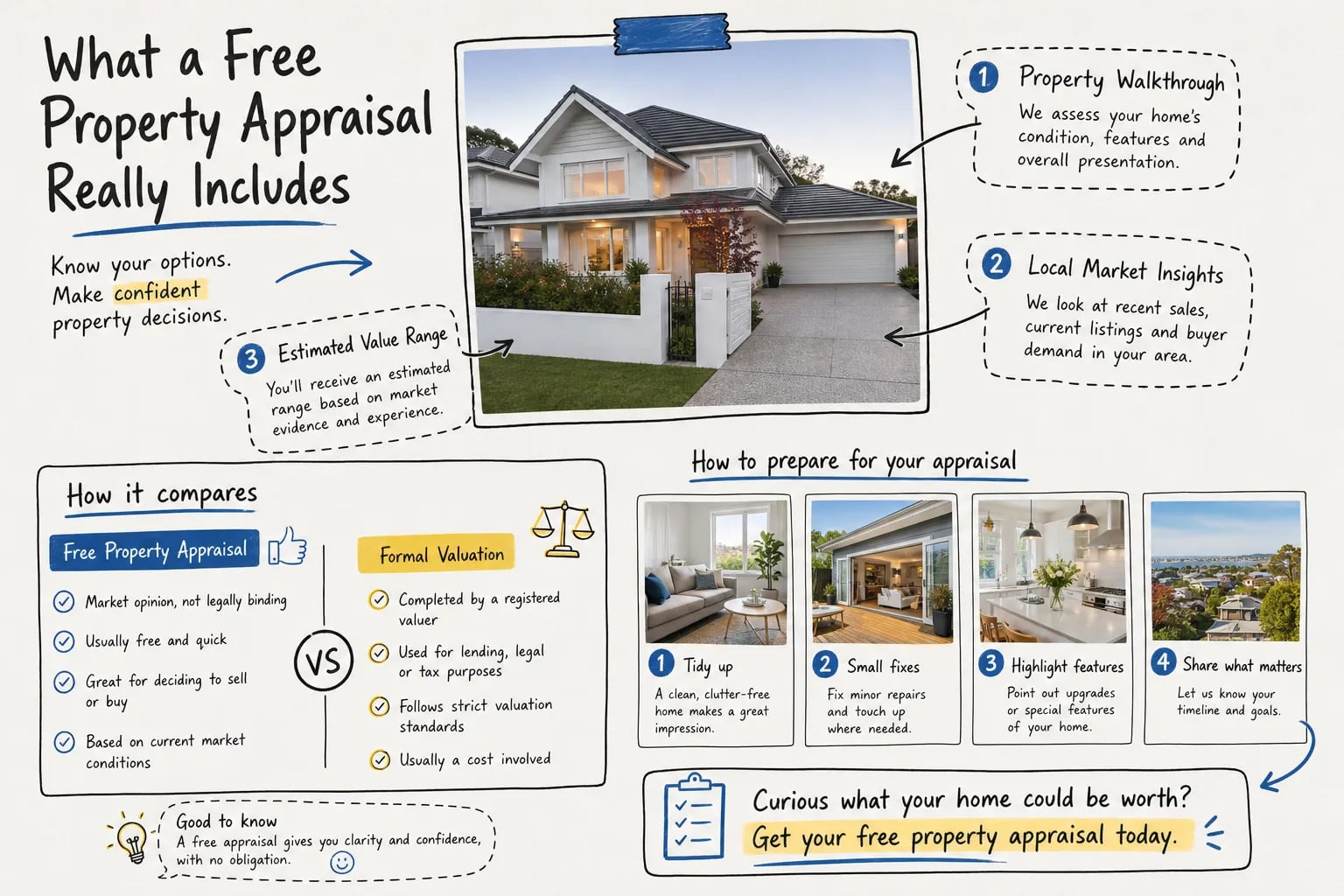
The distinction that trips up most homeowners is this: a free market appraisal and a formal registered valuation are not the same thing, and they're not interchangeable. A market appraisal is a licensed agent's professional opinion of what your property is likely to achieve in the current market. A registered valuation is a paid, formal report prepared by a valuer registered under the Valuers Act 1948, and it's typically required for lending, legal, estate, or court purposes.
In Auckland, a registered valuation generally costs between $700 and $1,200 for a standard residential property, sometimes more for complex or unusual homes. The two figures can legitimately differ because they're designed to answer different questions. Neither figure is inherently flawed, but using the wrong type in the wrong situation creates real problems. If your bank needs a valuation for mortgage purposes, your agent's appraisal won't satisfy them.
Equally, if you're just trying to decide whether it's the right time to sell, a full registered valuation is unnecessary expense.
A reputable estate agent's appraisal should cover far more than a single figure scribbled on a notepad. You should expect a thorough inspection of your property's interior and exterior, comments on land and floor area, layout, age, condition, renovation quality, heating and insulation, and outdoor features. The agent should then support their price range with comparable sales from your suburb or nearby streets, adjusted for differences in size, condition, and features.
The appraisal is free because the agent is seeking your listing. That's worth understanding clearly, not as a reason to be suspicious, but as context. A good agent earns that appraisal appointment by giving you genuinely useful information, not by telling you what you want to hear. Look for measurable signs of quality: written comparables, documented adjustments, and a clear explanation of any limitations in the data.
A well-reasoned appraisal is also their best advertisement for why you should work with them.
From the moment an agent pulls up outside, they're building a picture of your property against the current buyer pool. They're noting street appeal, condition of the cladding, roof, landscaping, and driveway before they've even reached the front door. Inside, they're assessing layout and flow, natural light, the quality and condition of the kitchen and bathrooms, flooring, heating systems, and any visible signs of deferred maintenance.
They're also looking for anything that could reduce buyer confidence: unconsented additions, access issues, signs of moisture or weathertightness concerns, or work that appears to have been done without building consent. This is the part homeowners often underestimate. A good agent doesn't just admire what's working; they're quietly tallying what buyers will question, because those questions will arrive at negotiation time whether you're ready for them or not.
After the inspection, the agent pulls recent comparable sales from your suburb or nearby streets, typically three to four well-matched properties. They then adjust those comparable prices to account for differences in size, condition, features, and location relative to your home. If a comparable sold for $950,000 but had a significantly superior kitchen while your property has a larger section, those differences are factored into the adjusted figure.
Under Real Estate Authority guidance, the final appraised range should generally have a spread of no more than 10%. This is where a local agent's knowledge genuinely earns its keep. A local agent who knows your suburb intimately reads the buyer market differently from someone reviewing data from across town, they know which streets command a premium, which school zone catchments shift value considerably, and how buyers are behaving right now rather than six months ago.
For Auckland properties specifically, a comprehensive market appraisal should account for Auckland Council zoning classifications, flood plain designations, building consent records, and any site-specific risks. These details genuinely affect buyer appetite and market value, yet they're invisible to any automated online tool. Auckland Council mapping identifies parts of Epsom and Mt Eden as areas where flood risk is a material concern, and a flood plain notation on a LIM can meaningfully reduce buyer demand and, in some cases, trigger a price discount in the range of $70,000 to $100,000 relative to comparable low-risk homes nearby.
Auckland's Unitary Plan has also significantly changed zoning across Central Auckland suburbs, with many properties previously in Single House zones now sitting in Mixed Housing Urban or Terrace Housing and Apartment Buildings zones. That zoning shift can represent substantial development potential, which a thorough appraisal should reflect. A well-informed local agent will factor in not just what the house is worth today, but what the site represents to buyers who understand the land's potential, and that is exactly the kind of context a free property appraisal in Auckland from Team Thompson aims to provide for Epsom, Mt Eden, and Central Auckland properties.
Two properties with the same bedroom count and floor area on different streets can carry very different values. School zone catchments, flood risk, aspect, proximity to noise sources, and local buyer demand all influence what buyers are willing to pay.
In Epsom, average three-bedroom sale prices over the six months to June 2026 sat around $1.57 million, and a property inside a sought-after school zone commands a meaningful premium over an otherwise comparable home just outside it. The only way to understand that premium accurately is to have been negotiating those transactions on those streets.
Online valuation tools carry a median error of around 6% for Auckland properties, but in practice, a working margin of 10 to 15 percent is more realistic. For unusual, renovated, or poorly maintained homes, the figure can reach 20 percent or more. On a $1.2 million property, a 15 percent margin is $180,000 in either direction. That's not a planning figure; it's a range too wide to make financial decisions with any confidence.
The reason automated models miss is straightforward: they can't see inside your home. They can't assess renovation quality, interior condition, micro-location factors, flood and zoning risks, or the premium buyers place on a particular street's quiet character. Industry analysis of Auckland sales has found that only around half of transactions fell within 10% of an online estimate, with roughly 76% falling within 20%. Those figures should give any homeowner pause before using an online valuation to set an asking price.
Online estimates are useful as a first filter, particularly for tracking general suburb trends over time or getting a rough sense of whether your property is in a $900,000 or $1.4 million bracket before you contact an agent. They're a reasonable starting point, not a finishing point. The moment you're considering a sale, planning your next purchase, or trying to compare what different agents think your home is worth, you need a proper agent appraisal behind the number.
An online property appraisal tool in Auckland can point you in a general direction, but a no-obligation property appraisal in Auckland from a local agent gives you something you can actually act on.
An agent needs your address and access to your property. Beyond that, homeowners who come prepared with supporting documents consistently receive a more accurate estimate. The most useful items to have on hand include:
Before the walkthrough begins, flag anything that could affect value in either direction. Mention anything relevant: recent roof work, a new kitchen, unconsented additions, known drainage issues, or any plans for the surrounding area you're aware of. All of this helps the agent give you a more grounded figure. Agents can only factor in what they know, and a brief five-minute conversation before the inspection almost always produces a better appraisal than a silent tour followed by a question session at the end.
A price range isn't vague; it's intentional. The lower end of the range reflects conservative buyer behaviour, slower market conditions, or a property that needs some preparation before going to market. The upper end reflects strong presentation, competitive buyer interest, and favourable timing. Understanding what moves a property toward the top of its range helps you decide how to allocate your pre-sale budget: where a fresh coat of paint genuinely adds value and where it doesn't.
Getting two or three free appraisals before committing to an agent is sound practice. When you do, compare not just the price range each agent gives you but the depth of their reasoning. Which comparable sales did they reference, and how recent are they? How well do they understand the local buyer pool? Can they speak specifically to what buyers are asking about in your suburb right now? An inflated number without evidence is a red flag. A well-reasoned range supported by recent local sales is a sign of someone worth working with.
Team Thompson offers a free, no-obligation property appraisal in Auckland for homeowners in central Auckland and beyond.
Book a free property appraisal with our team and benefit from coverage that includes zoning context, flood plain considerations, and recent suburb sales from streets we know well. If you're weighing your options, it's a practical and pressure-free place to start. Reach out to our team to book a time that suits you.
A free property appraisal in Auckland is a genuinely useful tool when it's done properly. Knowing what a good one covers puts you in a much stronger position when it comes to timing your sale, setting realistic price expectations, and choosing the right agent to work with. The distinction between an agent's market appraisal in Auckland and a formal registered valuation matters, and now you understand which one serves which purpose.
If you're curious about what your Auckland home is worth in the current market, the most useful next step isn't another online search at midnight. It's a conversation with a local agent who knows your suburb, understands what buyers are doing right now, and can give you a grounded, evidence-based picture of where your property sits.
That conversation costs you nothing and gives you something the internet simply can't.
"When you are ready to sell - so are we" #teamthompsonnz

